Website slowly developing. Seo updated on 20th June 2026
The Bronte sisters all wrote novels published between 1847 and 1857. They lived together, died young and retained the same surname. The Strickland sisters became famous for different types of writing, at different times in the 19th century, some emigrated to Canada, married and they all lived long and varied lives.
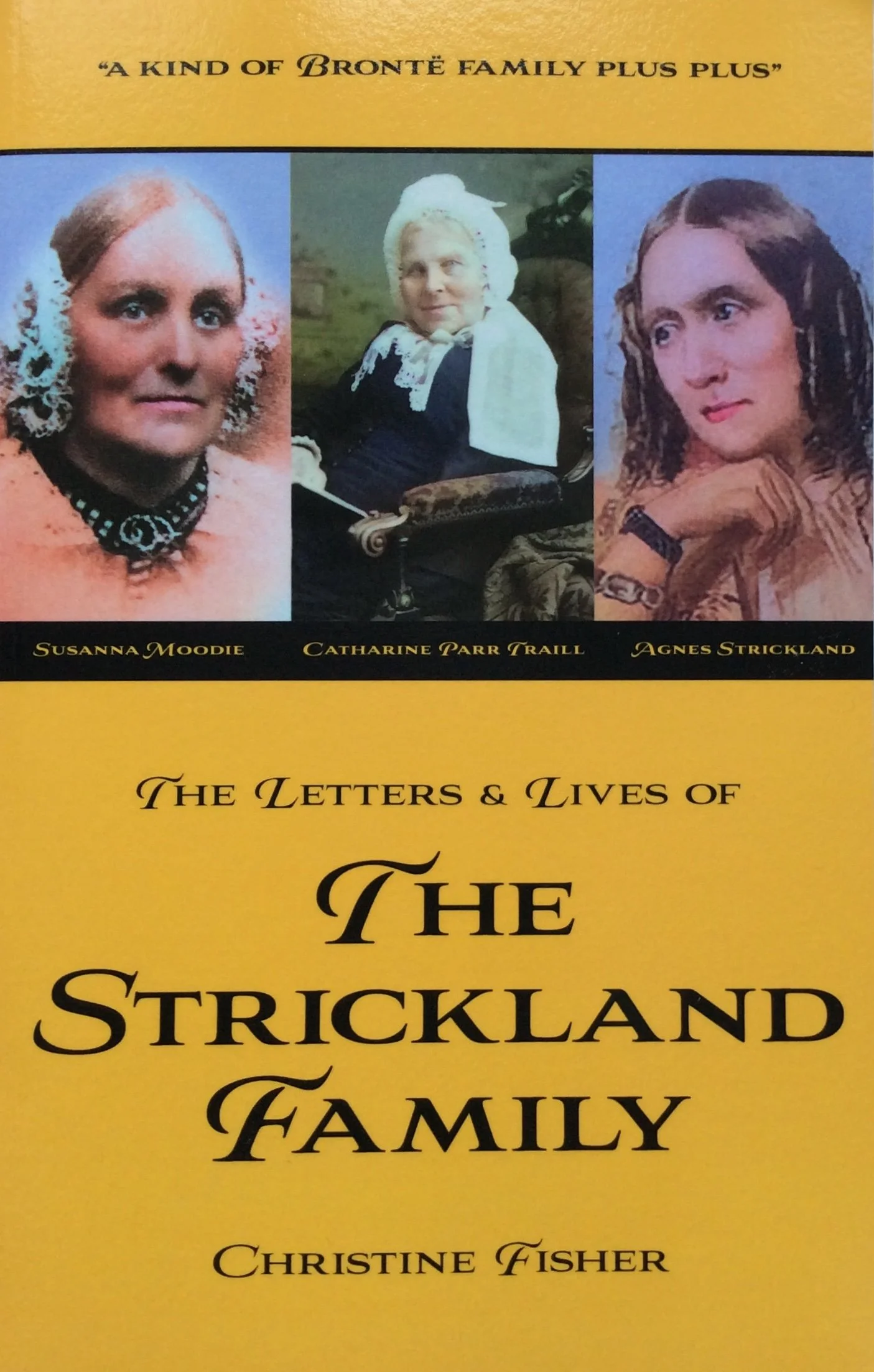
There are many biographies about the Bronte family. “The Strickland Family” by Christine Fisher is the only biography of the whole Strikland family, the most famous being Agnes Strickland, Susanna Moodie and Catharine Parr Traill. This book adds much to what was previously known about the individual family members.
About the author: After retiring, Christine Fisher re-read ‘Lives of the Queens of England’ and, not for the first time, wondered how one woman, using quill pen and paper, could have produced this major historical work in such a short space of time. From that simple beginning, this book has emerged. Christine continues to learn about the family, their descendants, their continuing fame or otherwise, and hopes to develop a blog to put this additional information into the public domain.
Reviews
“They were a remarkable family of writers and need to be celebrated as such” - Peterborough Examiner, Ontario, Canada
“The book is long yet it reads easily and is enjoyable” - Trent Valley Gazette, Ontario, Canada,
“That’s a good book. Have you read it?” - remark made by a visitor to an exhibition about Agnes Strickland in Southwold, Suffolk, England
Details: A copy of the print-on-demand paperback can be ordered through any bookshop or online via (for example) Amazon - where a preview is available; ISBN 978-1-83975-157-8; eBook ISBN 978-1-80381-155-0
Agnes Strickland (1796-1874) “Lives of the Queens of England” introduced a new type of history book - enjoyable to read as well as factually correct. Agnes was an international celebrity who succeeded in keeping secret that her sister Elizabeth Strickland (1794-1875) was often her co-writer but insisted on anonymity. They both were born, lived and died in England.
Susanna Moodie (1803-1885). Poet and novelist, most famous for “Roughing It in the Bush”, her dramatised recollections of her early life in Canada after emigrating from England with her husband and baby in 1832.
Catharine Parr Traill (1802-1899) combined writing for children with serious botanical works such as “Studies of Plant Life in Canada”. She emigrated from England to Canada in 1832 with her husband, who was unsuited to the hard physical labour of a pioneer farmer. She always needed financial and practical help from her sisters Agnes, Jane and Sarah in England and from her brother Sam and his family in Canada. ‘Traill College’ in a Canadian university is named in her memory.
Sam Strickland (1805-1867) emigrated to Canada aged 19. He carved out his farm from dense forest and was successful both as a farmer and a businessman. He is commemorated in Lakefield, Ontario where he was one of the original settlers. His sisters Catharine and Susanna are also commemorated there.
Jane Margaret Strickland (1800-1888) poor health and caring for their ageing mother restricted her life. She earned a living in various ways - editing Christmas annuals, proof-reading for her sisters plus writing a detailed history of Rome, a romantic novel and a biography of her sister Agnes Strickland. She lived most of her life in Suffolk, England.
Sarah Strickland Gwillym (1798-1890) was the beauty of the family. She married and was widowed twice.Her face is familiar to many Canadians because a portrait of her as a young woman has been given much publicity in the mistaken belief that it was a portrait of her sister Catharine. Her second husband, a vicar in Lancashire, left her a lifetime interest in his considerable assets and she gave financial support to other members of her family, particularly to Catharine. She lived and died in England.
Captain Tom Strickland (1807-1874) joined the Merchant Navy aged 14. He became a Master Mariner and was captain of sailing ships that took him as far afield as India, Australia, the United States and Peru. His wife sailed with him for many years and several of his children were born at sea. When not at sea, he lived in England.
Excerpts - one from each decade
Pre-1809 Catharine remembers when Sam was born in 1804: “The nurse came down and told us that we had a baby brother. She told us that nobody would think of us now. We could not understand nurse’s meaning - six girls to be made of little account for the sake of one tiny baby boy!! Just eleven months younger than little Susie. I was taken upstairs with the rest of my sisters to look at this wonderful little brother only a few hours old, and hearing him cry when my sister Jane tried to open his tiny hand to present him with a small rag doll as a token of love and good will - but the gift was not appreciated by the ungracious baby as forcing open the little fingers rather roughly had disturbed the little gentleman’s slumbers and caused a noisy demonstration on his part, which alarmed the nurse who bundled us out of the room in double quick time - and the new baby was voted a cross ugly thing, not half as nice as the old baby.”
1810 to 1819: Thomas Strickland after his period of becoming increasingly an invalid, died suddenly of a heart attack. Catharine wrote “In the May of 1818 we lost our dear Father. A sudden attack of the gout seizing his heart was the cause of his death. It was our first great cause of sorrow” … In accordance with his wish to be buried in a quiet churchyard if he died in Norwich, he was buried at Lakenham, two miles south of Norwich Cathedral just outside the city walls.
!820 to 1829: in a letter written in 1826 to her friend Emma Bird in Yoxford, Susanna wrote “I take the opportunity of my brother passing through Yoxford on his way to London to beg your acceptance of a basket of apples for the children … My brother received a hasty summons last night to rejoin his ship bound for India immediately so that you may imagine the bustle and confusion his sudden departure has occasioned but we are scarcely allowed time to think of the long and painful separation that is about to take place…”
1830 to 1839: Sam heard the news that William IV had become King when he was working in the backwoods of Canada in 1830: “Mr Prior ascended a large stump, and in a loyal and patriotic speech read the proclamation, which was received by nine rounds of British cheers. Our party formed a large circle by joining hands and sang the national anthem, accompanid by the Goderich band, which was composed of two fiddles and a tambourine. His Majesty’s health was then drunk by means of a pail of whiskey, with a tea-cup floating on the surface, being handed round, followed by another pail of spring water. The eating and drinking part of the festival now commenced in earnest. We seated ourselves on the ground, under the shade of four or five immense trees. In the centre of the group, the union-jack waved gracefully over our heads.”
1840 to 1849: Agnes was in France in 1844 with Elizabeth and their maid, researching the lives of the Stuarts in exile. They needed transport from the station at Chatou a mile to their final destination. Agnes reported “a sturdy old man with a flat leather cap much the worse for wear, seized our carpet bags and trotted off with them at so brisk a pace that we had much ado to keep him in sight, nor did we come up with him till he had tossed our luggage up into a sort of go-cart of the rudest construction. Remembering the caution of an experienced traveller ‘Whatever you do, never lose sight of your baggage’, we entered the vehicle.”. The driver kept reassuring them by saying ‘Bon, bon’. Agnes said “Our maid Harriet who was infinitely more disgusted than ourselves and did not understand French, said ‘If the old man’s buns are not better than this ramshackle old shay, they won’t be worth eating’ “. This amused Agnes so much “that I never left off laughing as long as I remained” in the vehicle.
1850 to 1859: A number of Mrs Strickland’s Canadian grand children and their friends stayed in Reydon Hall, and they generally seemed to be young unmarried men … the bachelor status of the visitors sometimes caused difficulty … Whoever he was, Mr Leigh had got himself into mischief on his trips to England as Jane (in Suffolk) wrote in a letter to Catharine (in Ontario) … “His proposing to Miss Hawker after his marked attention to Charlotte will make him unwelcome … It was necessary to tell her what she was sure to hear … We like Mr Leigh much as a clever amiable and accomplished young man … However he is a dangerous companion for young ladies with the Atlantic between him and them”… Jane asked Catharine to sort out the problem “Will you dear Kate make her wishes known. It is an awkward task for you … but I am sure you can manage it.”
1860 to 1869: Sarah (wife of the minister of Ulverston, Lancashire) in a letter to Catharine in January 1864 wrote “I took cold on Christmas Eve - my dear husband gave meat to a hundred poor parishioners for their Christmas dinner and I and my housekeeper cut and portion it according to the number in the family and got it all away with my own hands. The day was so cold and perishing” and the meat was taken round in an open carriage that Sarah had become seriously ill. Sarah wrote “I like to help my dear excellent husband all I can and not add to his anxiety … there is so much to do in the parish”.
1870 to 1879: Among the telegrams which Jane sent as soon as Agnes had died (July 1874) was one to Elizabeth asking her to go to Southwold as soon as possible. Jane sent the telegram first and read Agnes’s Will second, and then rather regretted her haste … Elizabeth soon gave her side of the story in a letter to Catharine. She wrote “My dear sister, I had just crossed my garden and entered Captain Tom’s living room to see how the gout was dealing with him our brother when the Telegram followed me to announce the death of our sister Agnes that morning, ‘come quickly was added’. I was suffering with a severe cough but I contrived to travel to Southwold on Wednesday I received a letter from Jane requesting me to stay away hinting vexation was awaiting me.”
1880 to 1889: While Catharine was in Toronto paying her last visit to Susanna, there was excitement and anxiety about another uprising … led by Louis Riel. In a letter … Catharine said “There is excitement in every house in the city. The volunteers are marched out today to Winnipeg - the report is that eight of the men who went against Riel and his rebels are killed and another fight imminent at Prince Albert on the Saskatchewan … I only hope Hargrave will not be moved to go out…” Catharine was here referring to her grandson … the son of her daughter Mary.
1890 to 1899: (In August 1897) Catharine was still writing with style. (In a letter) she said “Now within the last week I have had much pleasure through a letter from my valued friend Mr Edward Roper. After the great day of the Queen’s jubilee … I wrote a long letter to Mr Roper and gave him some account of the doings of the jubilee day … which I knew would interest him. I forgot all about it but it had pleased him so much that he actually sent it to the dear Queen to read - And he says ‘She did read it’!”